

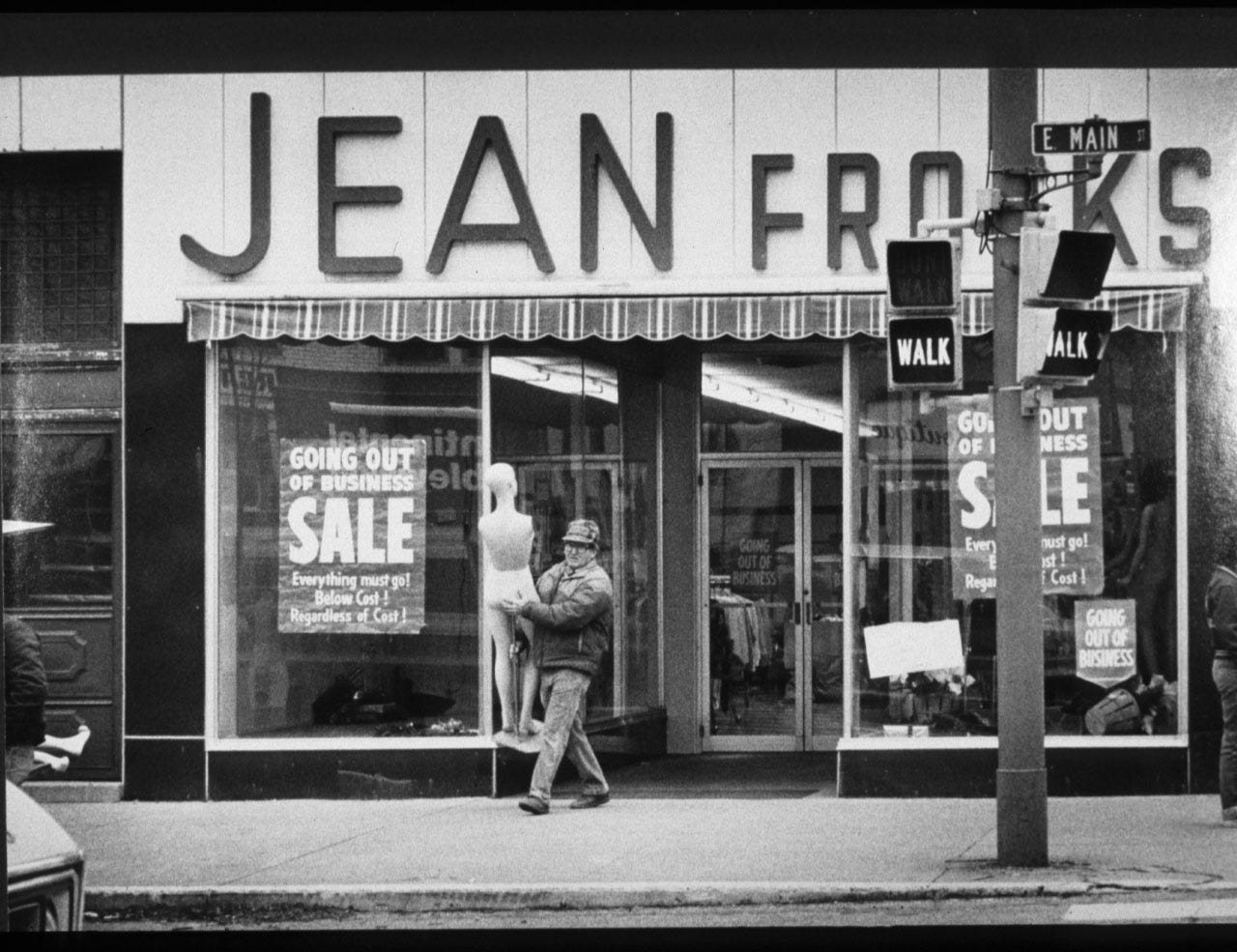
Here’s a story from 30 years ago that would make no sense today.
It’s 1992. Pearl Jam’s debut album Ten is selling well. But then MTV puts the music video for their song “Jeremy” in heavy rotation, and the band rockets into superstardom—shows suddenly sold out, fans smashing record store windows, the whole shebang.
That’s familiar enough, but what happens next is not. Pearl Jam responds to this hullabaloo by refusing to make music videos for the next five years. They decline photoshoots and interviews. When their producer tells them that their song “Better Man” is a surefire hit, they cut it from their second album.1 Nevertheless, that album sells nearly a million copies in its first week, setting a record. Then it sells six million more, staying at #1 on the Billboard chart for over a month.
They say that the past is a foreign country, and reading a Pearl Jam profile from the early 90s, it certainly feels that way. The writer takes for granted that fame is inherently bad. And not just because fans might, say, break into your backstage dressing room and steal your notebooks—which they did—but also because commercial success and artistic integrity are so obviously at odds with one another. Kurt Cobain had mocked the band for catering to the mainstream, and the criticism clearly stung. It was understood that being popular was somehow, paradoxically, uncool, and that Pearl Jam owed everyone assurances that they hadn’t gotten too big for their britches.
I am just barely old enough to remember this era, when “selling out” was a bad thing you did with your career, rather than a good thing you do with your stadium tour. Blank Space: A Cultural History of the 21st Century, the book where I first read this story about Pearl Jam, quotes the 90s chronicler Chuck Klosterman: “the concept of ‘selling out’ [...] is the single most nineties aspect of the nineties”. I gained consciousness at about the time that Backstreet Boys, NSYNC, and the Spice Girls gained worldwide fame, and I understood that it was hip to hate them.2 This didn’t stop them from selling millions of records, of course. But there was a sizable sector of society that refused to join in, a clutch of (sometimes snobby) purists who were ready to turn on anyone who got too big or too rich. As the music writer Chris Dalla Riva points out, around this time, a rock band could lose permanently lose their street cred for appearing in a Miller commercial.
That feeling part of a larger anti-consumerist vibe percolating through culture at the time. This was the era of Super Size Me and the anti-World Trade Organization protests that came to be known as the Battle of Seattle. My parents furnished me with copies of Eric Schlosser’s Fast Food Nation and Naomi Klein’s anti-capitalist manifesto No Logo.3 My English teacher made the whole class read anti-consumerist YA novels like Feed and The Gospel According to Larry. I got so caught up in the fervor that I almost showed up to a school dance with a handmade sign that said “I AM PROTESTING CONSUMERISM”. I chickened out at the last second, but clearly there was some potent zeitgeist going on if a 13-year-old was about to stake their reputation on, I guess, not buying stuff?
Fast forward to today, and that zeitgeist is long gone. Meghan Thee Stallion is a Popeyes franchisee, Drake would like you to try online gambling, and Maroon 5 is covering Bob Marley’s “Three Little Birds” as a tribute to Hyundai.4 Shortly after she charted her first hit, the rapper Ice Spice was partnering with Ben Affleck and Dunkin’ Donuts on an Ice Spice Munchkins Drink.5 We’ve got punk icon Iggy Pop selling insurance and Bob Dylan appearing in a Victoria’s Secret commercial.6 Lollapalooza once featured alt rock and heavy metal; these days, you can catch a set by DJ D-Sol, better known as David Solomon, the CEO of Goldman Sachs. And if you love Lady Gaga’s album Chromatica and the associated HBO special Gaga Chromatica Ball, then don’t miss these limited edition Lady Gaga Chromatica-themed Oreos!
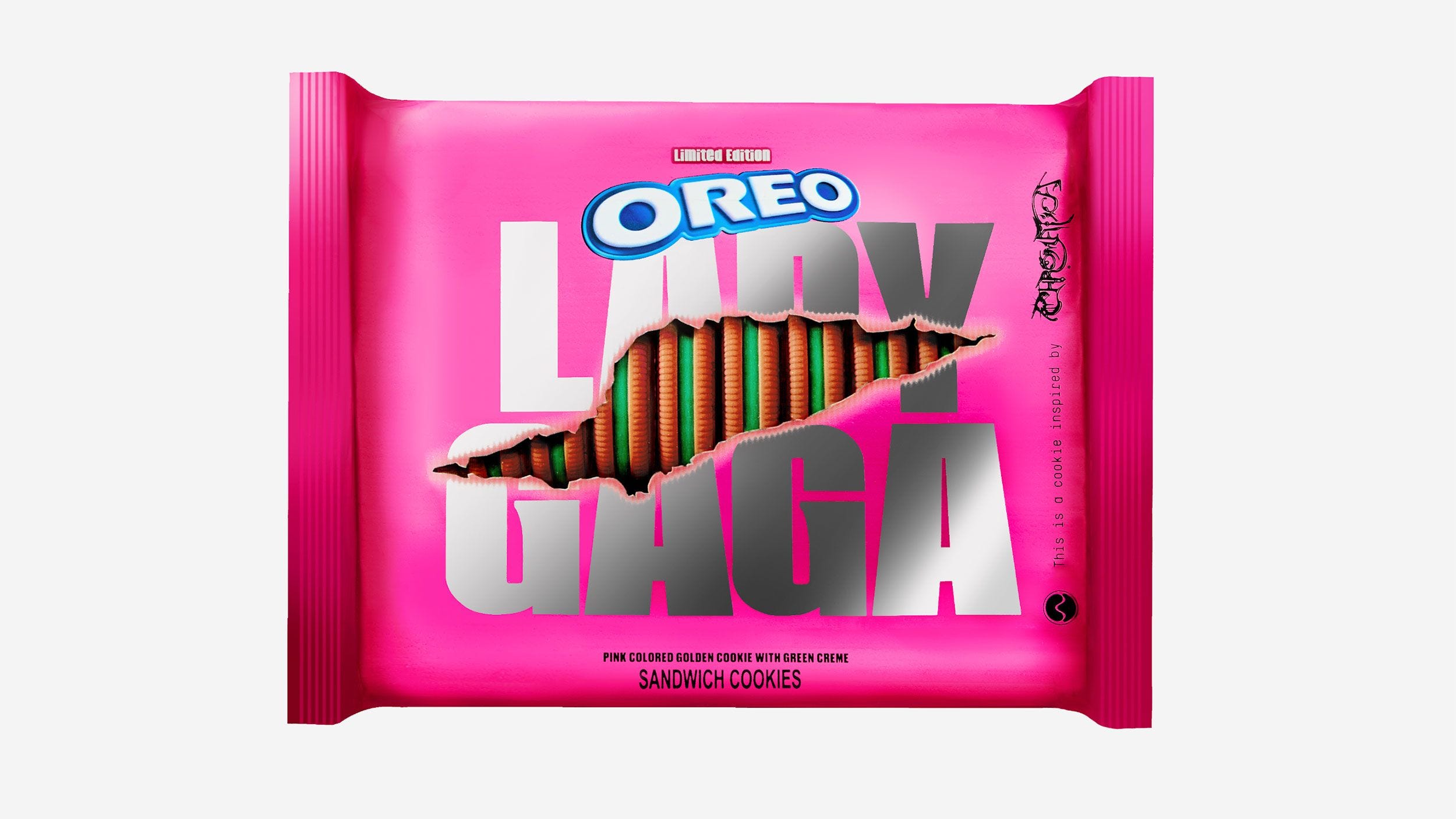
Hyper-commercialism is nothing new, in music or anywhere else. (See, for instance, the band KISS’ officially licensed Kiss Kasket). People who bemoan our era of “late capitalism” rarely realize that phrase is 100 years old. The only thing that’s unprecedented about these craven cash-ins is how well they seem to be working. Selling out no longer carries a stigma—if anything, fans are excited for tie-ins between their favorite bands and their favorite brands, no matter how shameless. The Chromatica Oreos reportedly flew off the shelves, earning a thumbs-up even from the Washington Post’s food critic. Some people complained about the texture and the color, or how it was simply a re-release of the much-hated “golden” Oreo, but they did not complain that it is cringe, perhaps even depraved, for a musician to collaborate with an international food conglomerate to stick her name on a million mass-produced sandwich cookies.
And if that doesn’t send Kurt Cobain spinning in his grave, wait until he finds out that Gen Z thinks Nirvana is a clothing brand.
ONCE YOU POP, YOU CAN’T STOP
How did the punk ethos die?
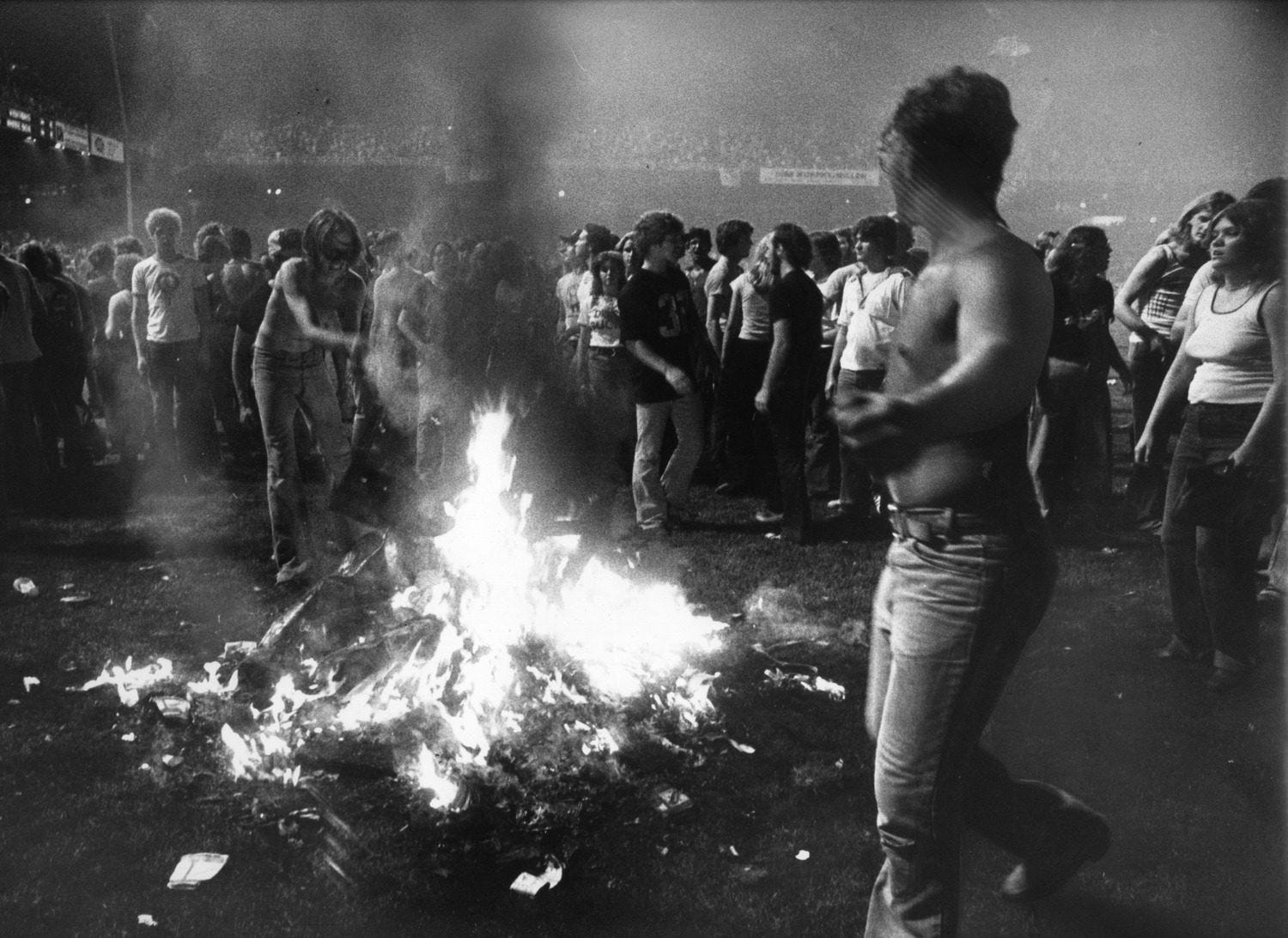
W. David Marx, the author of Blank Space, has a theory that I think is correct, but incomplete. He blames an ideology called poptimism: the idea that popular art (and especially pop music) is just as meritorious as any other kind of art. Poptimism was meant to be a reaction to rockism7, a strain of cultural snobbery that insisted rock ‘n’ roll was the only authentic form of art—if it ain’t a white guy with a guitar, it ain’t real music! Both sides of that debate might sound stupid now, but the poptimist critique made sense back when people were flocking to baseball stadiums to blow up piles of disco records:
Unfortunately, Marx says, the critics took poptimism too far, and they brought the discourse with them. They embraced pop music not only because they had suddenly discovered the musical genius of Britney Spears, but also because they realized the political winds had changed. In the words of one music writer, poptimism was “a kind of penance, atoning for past rockist misdeeds”. Saying that some art is better than other art started sounding too much like saying that some people are better than other people. And once you’re unwilling to judge art for its artistry, you’re stuck judging it by its popularity.
I don’t doubt Marx’s thesis that culture writers abandoned their posts, but I do doubt that this was enough to kill the anti-consumerist vibe on its own. Something even bigger was happening at the same time: while the critics were changing their tune, they were also getting tuned out. The internet decapitated art criticism, elevating the YouTube commenter to the same level as the Pitchfork editor. And although there are plenty of problems with professional tastemakers—they can be condescending and exclusionary, they can have their heads up their butts, etc.—they are at least, in theory, concerned with separating art from schlock.
Casual consumers have no such hangups. They don’t care whether every pop song they listen to is written by the same middle-aged Swedish guy; they just want their eardrums vibrated, their retinas tickled, and their pleasure centers stimulated. And so, the more you cater to the consumer over the connoisseur, the more you’re going to be serving up slop. The internet makes this possible; competition makes it irresistible.
Together, the decline of art criticism and the ascent of art populism can explain how corny, lowest-common-denominator kitsch went from being a guilty pleasure to simply being a pleasure. The line separating art and entertainment went undefended, and then it was washed away by a tsunami of swill.
However, that doesn’t explain why we became so tolerant of shameless greed and self-promotion. As we lost the ability to distinguish between Joni Mitchell and Celine Dion, why did we also lose the ability to distinguish between a single and a jingle? Listening to Lady Gaga is one thing, but where did we acquire our appetite for her Oreos?
The answer to that is, I think, the Great Switcheroo.
DOWN WITH THE RICH, UP WITH THE FAMOUS
In every country on Earth, poor people outnumber rich people. Many of those countries are ostensibly democratic. This leaves us with a puzzle: why don’t the poor people vote to take all the money away from the rich people and redistribute it amongst themselves?
John Steinbeck’s famous explanation was that, in the United States at least, poor people see themselves as “temporarily embarrassed millionaires”.8 You don’t want to outlaw affluence if you might have some for yourself one day. That wasn’t a crazy thing to think when Steinbeck was writing in the 1930s, as some of the richest men in America had come from modest means—Rockefeller, Carnegie, Ford, Edison, Hershey, and Chrysler. If fortunes are popping into existence all the time, it may seem like the wealthy are a group to be joined rather than beaten.
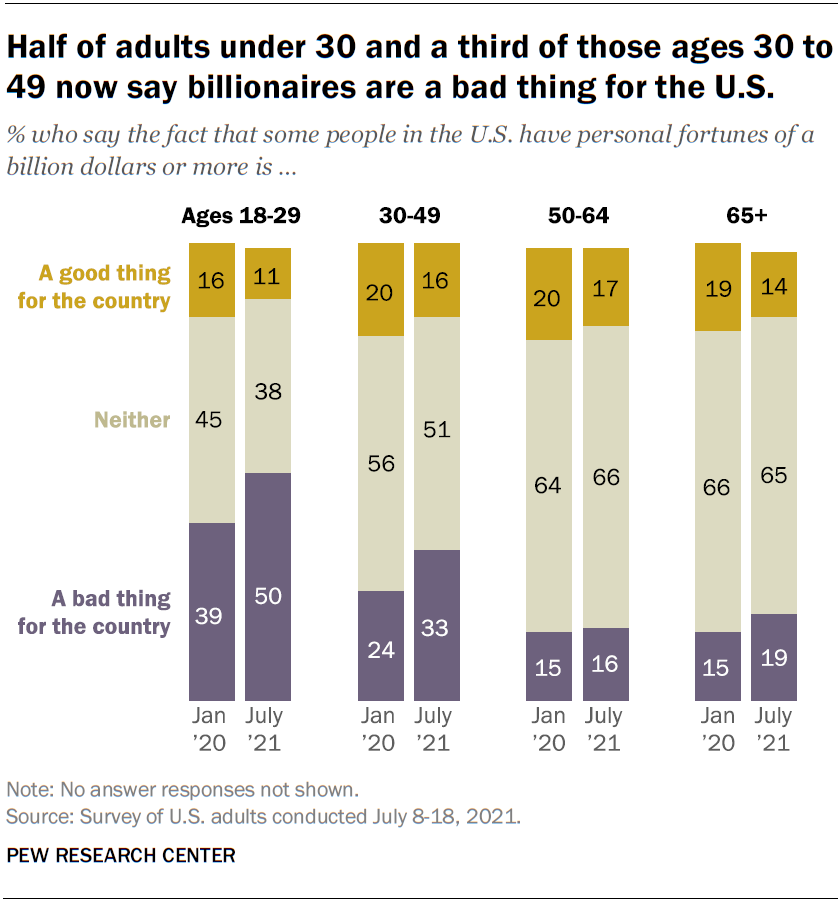
The average American is not feeling so upwardly mobile these days, and so people aren’t as sanguine about the super-rich as they might have once been. When YouGov surveyed Americans about their opinions of 40 different rich people, not a single one of them was liked by more than 50% of the population. (For instance, 90% of respondents know who Jeff Bezos is, but only 19% approve of him). An increasing number of people—and especially young people—say that billionaires are a bad thing for the country:
As the public has soured on the rich, however, they seem to have sweetened on the famous. In similar YouGov polls, celebrities do extraordinarily well compared to billionaires. Lady Gaga, for instance, has 97% recognition and 61% approval. Samuel L. Jackson: 96% recognition, 81% approval. Even Paris Hilton’s 40% approval rate is better than every single rich person except Warren Buffet (he’s at 41%).9 Not bad for someone who once described her life’s mission as, “I want to be famous. [...] And I want to monetize that, like a lot.”10
This Great Switcheroo happened, I think, because as it got harder to become rich, it got easier to become famous. It’s hard to remember now, but going viral on the internet was once a bad thing. Back in 2002, when Star Wars Kid got famous for pretending to be Darth Maul in a home video, he got death threats, not brand deals. His classmates bullied him so badly that his family sued them; meanwhile, his school asked him not to come back. The “Numa Numa” Kid was originally “distraught” and “embarrassed” by his fame (he later tried to capitalize on it, mostly unsuccessfully). Afro Ninja, a Black stunt performer whose disastrous audition tape went viral, said of his unexpected notoriety, “If I had a choice to do it all over again [...] I would pass”.
Once the attention economy built out its financial infrastructure, however, overnight fame suddenly went from painful to profitable. The YouTube Partner Program (2007), Stripe (2010), and Patreon (2013) all made it easier to turn eyeballs into dollars. The first wave of internet celebrities peaked too early to cash in, but subsequent waves became icons rather than pariahs. Just as the Americans who lived through the Gilded Age watched industrial moguls build business empires, we watched tweens become millionaires in their bedrooms. They got Andrew Carnegie; we got Mr. Beast.11
As a result, the attention economy is the one corner of the overall economy where people are still feeling upwardly mobile. 57% of Gen Z (and 41% of older adults!) say they would like to be influencers. And why not? You are not going to escape the underclass by driving an Uber or dusting the server racks at a data center, but you might be able to do it by posting mukbang videos.
I think this is why we now tolerate such blatant greed among famous people: we think we have a chance of becoming one of them. We once saw ourselves as temporarily embarrassed millionaires; now we see ourselves as temporarily unknown celebrities.
(Of course, the celebrities we look up to are also millionaires, but their riches are incidental to their fame, rather than the other way around.)
It doesn’t matter whether you’re actually trying to become TikTok famous. The fact that there is a path between us and the stars—however tenuous, however unlikely to be trod—makes it feel like they are, somehow, just like us. You and I could never be Jeff Bezos, Bill Gates, or Sam Altman, and so they seem distant and despicable. But some part of us believes that we could be Billie Eilish, Ed Sheeran, or Taylor Swift, and so we exempt them from the noblesse oblige that we used to demand of the aristocracy.
In fact, while most of us feel like billionaires owe us something (see: the California Billionaire Tax, heading to ballots this fall), many people apparently feel like they owe something to their favored celebrities. Millions of people have joined the ranks of fan clubs like the Rihanna Navy, the BTS Army, Ariana Grande’s Arianators12, Justin Bieber’s Beliebers, Beyoncé’s Beyhive, and so on. The paramilitary-esque branding of these groups is not accidental. These are the folks writing guides on how to inflate BTS’s streaming statistics, issuing death threats to a music writer who dared to give Taylor Swift an 8.0/10, and enlisting themselves as copyright police when an Ariana Grande album leaked early, hunting down and flagging links to the pirated music so it wouldn’t hurt her advance sales. As the author of that BTS guide put it in an interview with The New York Times, promoting her favorite band feels like “we are also promoting our own voices, our own struggles, our own hope for a better world.”
This has got to be the greatest marketing coup in history: convincing fans that they are “promoting their own voices” while they are helping a record executive afford his second yacht.
TO BE OREO NOT TO BE
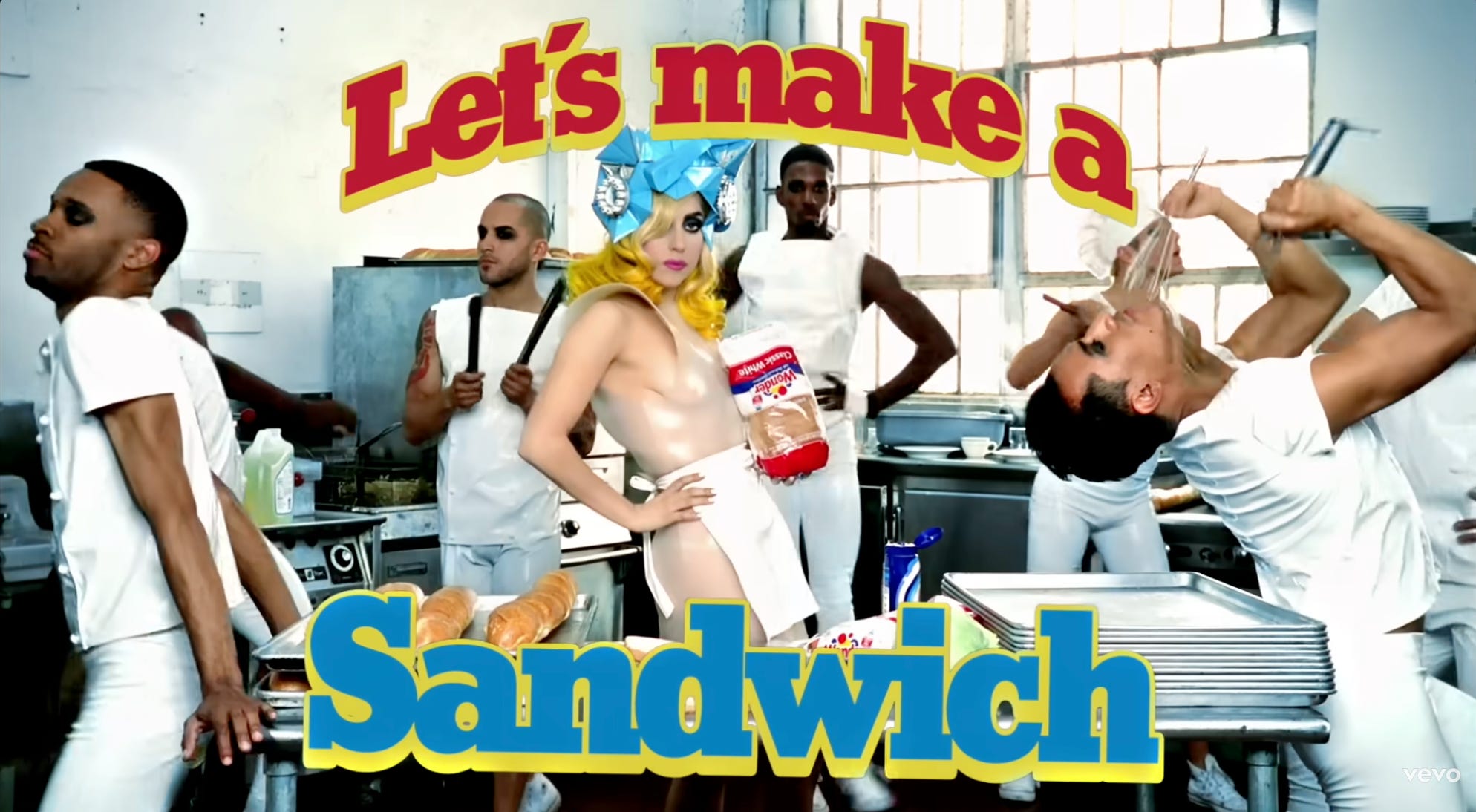
I’m being harsh, but look around: are you pleased with the state of our culture? Are you excited by music videos that double as commercials for Wonder Bread and Miracle Whip?13 Do you enjoy jockeying with ten million other people for Taylor Swift tickets, nine million of whom are attempting to invest in them as speculative assets? Does it warm your cockles when The Rock brags on Twitter that Red One, his Christmas movie, has “a long shelf life and multiple verticals - kudos to our Amazon partners for their strategic win”? This is what decades of poptimism, populism, and celebrity worship have gotten us:
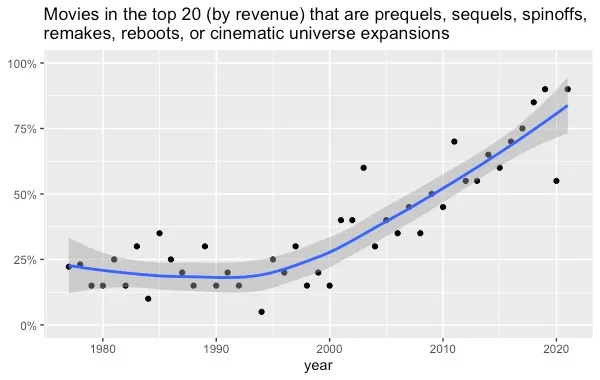
If we want this to stop, the solution is simple: we have to stop eating Lady Gaga’s Oreos. We have to stop pretending that celebrities are just like us, and that their success is our success. We have to redraw the line between art and entertainment, and more importantly, we have to redraw the line between art and advertisement.
I have no problem with artists making money—everybody has to pay their rent somehow. I don’t even have a problem with artists getting rich—if you can write a song that makes the whole world sing, then you deserve a big fat check.
I have a problem with artists doing commerce under the guise of art. I listen, I read, and I watch because I want to inhabit, even if just for a moment, the mind of another human. I want to feel what it’s like to be them, and in so doing, I want to better understand what it’s like to be me. But if I journey to the center of someone’s psyche and all I find there is a billboard for Pizza Hut, I’m turning around. If your art is just one node in your business empire, if your albums are merely commercials for your cologne, if you’re trying to turn your first billion into your second billion, you are no longer an artist at all. You are a credit default swap with a discography attached.
If we can revive the stigma of selling out, maybe we can also revive the rest of the punk ethos that we seem to have lost. To the extent that anti-consumerist sentiment survives at all today, it mainly exists in two diminished forms. One is the environmentalist variant, which says it’s naughty to buy stuff not because it’s bad for your soul, but because it’s bad for the Earth. That’s a fine way to feel, but there are plenty of ways to sell your soul without increasing your carbon footprint.
The other is the anti-capitalist variant, which says it’s bad for rich people to have so much more money than poor people do. That’s also a fair critique, but if you’re not careful, you can make it sound like it’s actually awesome to own tons of stuff, and the only problem with Birkin bags and Patek Philippes is that some people don’t get to have them.
We’re missing the most potent part of that 90s counterculture, the part that said there’s nothing noble about the act of consumption itself. I’d like to live in a world where a heavy metal musician who shills for margarine would become a laughingstock rather than a millionaire. Our world used to be a little more like that, and I think it could be again. We don’t need to revive rockism—it was always stupid to think that you can only make good art with a Fender Stratocaster. But we do need to revive our desire for seriousness among our cultural elite. If we’re going to let these people into our lives, they ought to stand for something more than themselves. They should to be willing to put their art ahead of their pocketbook and their follower count. And, ideally, they should not also be the CEO of Goldman Sachs. I have seen the future that awaits us if we fail to bring punk back, and it looks like this:
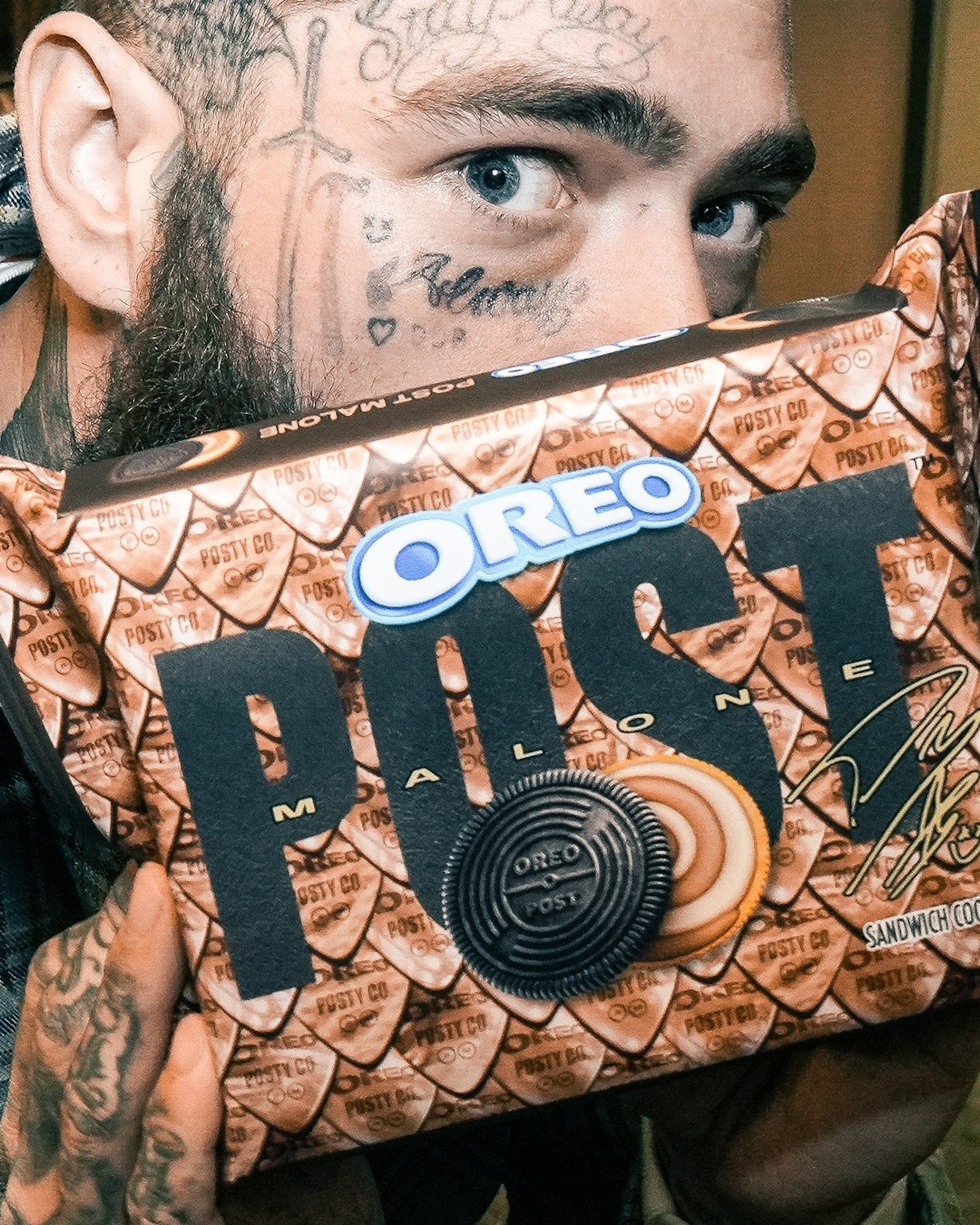
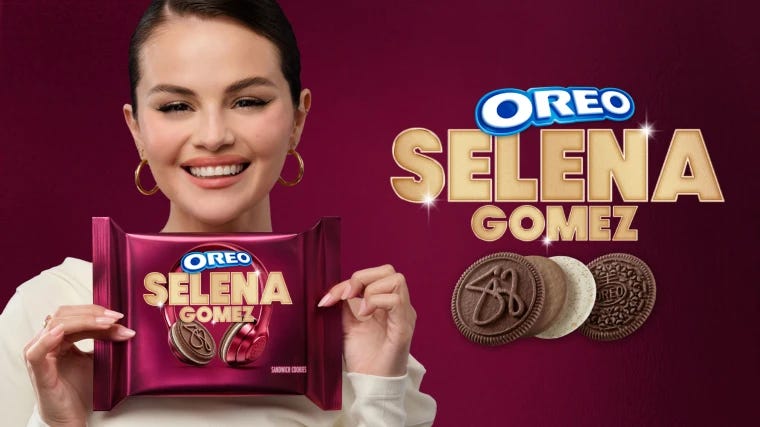
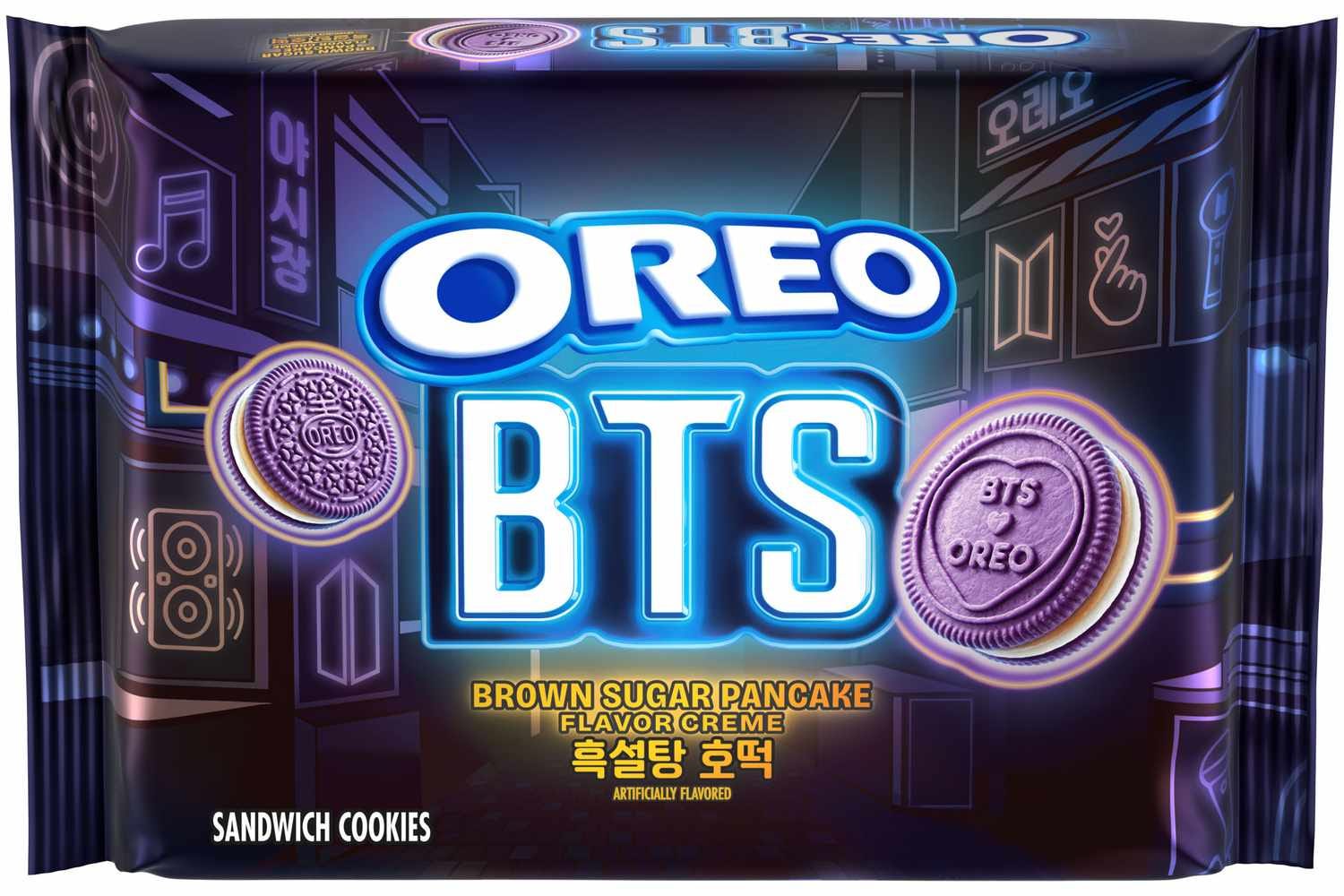
The producer was right: they later put it on their third album, and it spent eight weeks at #1 on the rock charts, despite not being released as a single.
I mean, c’mon, the founding members of NSYNC were former Mickey Mouse Club actors, and Backstreet Boys was assembled by a music producer in a blimp hangar in Orlando. The magazine ad that announced auditions for the group that would become the Spice Girls read like this:
WANTED: R.U. 18–23 with the ability to sing/dance? R.U. streetwise, outgoing, ambitious, and dedicated? Heart Management Ltd. are a widely successful music industry management consortium currently forming a choreographed, singing/dancing, all-female pop act for a recording deal.
If there is a less-cool origin story for a band, I’d love to hear it.
Always remember the Naomi Mnemonic:
if the Naomi be Klein
you’re doing just fine
If the Naomi be Wolf
Oh, buddy. Ooooof.
Maroon 5:
Bob Marley is one of the greatest artists in the history of music, he is truly a genius, so we were excited to be given the opportunity to cover ‘Three Little Birds” for Hyundai’s new campaign.
No relation to the Spice Girls nor to the dancehall artist Spice.
In the comments, Dylan fans claim this commercial is merely performance art. In 1965, a reporter asked Dylan, “If you were going to sell out to a commercial interest, which one would you choose?” and Dylan replied, “Ladies’ garments”. That means his Victoria’s Secret collab is more like a prophecy fulfilled than a legacy shilled. In that case, I, uh, also hereby declare that I would only ever sell out for a company that hawks brassieres, and so if I ever appear in a Victoria’s Secret commercial, rest assured I am during it in a cool and ironic way.
Gosh these names are terrible.
The “millionaires” framing of this quote is probably a later paraphrase. The original quote says “temporarily embarrassed capitalist”.
Michael Jackson is currently at 67% approval, which is impressive considering Netflix just released a documentary about whether he sexually abused children.
Blank Space, p. 44.
If Star Wars Kid had debuted a decade later, he’d probably be a Disney brand ambassador right now. Instead, he is making documentaries about the dangers of the internet.
No offense to Ariana Grande, but I would have encouraged my fans to pick something that didn’t sound like a rejected name for the Hitler Youth.
Somewhat tangential to the discussion about burning disco records: I watched a documentary about the Bee Gees and Barry Gibb believes that the reason the *Saturday Night Fever* soundtrack did so well is because the disco music was done by white guys. He believes racism was a key factor in the "disco sucks" movement, and it's hard to argue, particularly when you've already stated here that only "white guys with guitars" in rock music count as authentic. It's essentially the same argument black people have made about Elvis Presley stealing black music and making it palatable to a white audience. Both rocketed to stardom (or in the case of the Bee Gees, had a major comeback) with music originated by black/latino artists.
As a general rule, celebrity endorsements tend to turn me off a product. Tie in packaging, you’d have to pay me (and well) to use it even if I liked the celebrity’s work. No, not giving YOU money for that. Dunno if it’s because I was around for the nineties. Think I always kinda felt that way.
I think it’s just annoyance with the noise and commercialism. Not so much a reasoned boycott as a twitch. I can maybe excuse it if there is possibly relevant domain knowledge—a musician I like or an athlete performing well saying hey I like the instruments or equipment or sporting gear X company makes for Y reasons, I might pay some attention if it looks like they’re really saying it because that’s really their experience, and okay maybe that’s not unreasonable of them to do. Even then tho I’m probably more thinking, yeah, okay, taking note of your opinion and maybe I’ll give them a try but I do want to try them myself first. And always a little suspicious they were more looking at the endorsement money than the actual quality.
And generally, if you’re paying someone to endorse your cookies, or to let you print their name on them, you’re paying them to chase me away from them.
Even a product I already like enough to use, you don’t want to film a pop star saying I love those. It’s likely to make me less enthusiastic. I might look elsewhere. I think a part of me is thinking wait what’s wrong with those you feel you need to do this? Or more likely: I really am just a bit annoyed again.
It just seems cheesy, a little too manipulative. Granted, I get advertising is meant to be the latter: the message is always buy this. But while I get promotion is just part of commerce, and fine fair play saying we make a thing we think is good and we want you to buy, I find it, I dunno, kinda especially insulting to the intelligence a pop star saying hey now you can have Oreos with my name on them. Thanks, no. I think I’d be a little embarrassed having those in my kitchen. Don’t care if it’s trendy. I can live with being untrendy.