


Is AI going to take all the jobs, or what?
Seventy-one percent of American adults think that AI will lead to fewer jobs in the next 20 years. All over the world, a plurality of people agree. The CEO of Anthropic says that AI will spike the unemployment rate to 10-20% in the next 1-5 years. We can all hear the creaking and the screeching of the Terminators as they lumber toward us—not to kill us, apparently, but to do all of our graphic design, make all of our spreadsheets, and send all of our emails.
I get why people feel this way. It seems so obvious that as technology improves, unemployment should increase. One day you’re on an assembly line, screwing the doors onto washing machines, and the next day they invent a robot that can screw on 1,000 doors in a minute, and now you don’t have a job anymore.
If you take this kind of story seriously, though, shouldn’t unemployment have been steadily increasing since, say the Industrial Revolution? Shouldn’t we now be at 100% unemployment, or at least well on our way there? Why instead is the unemployment rate basically where it was 80 years ago?
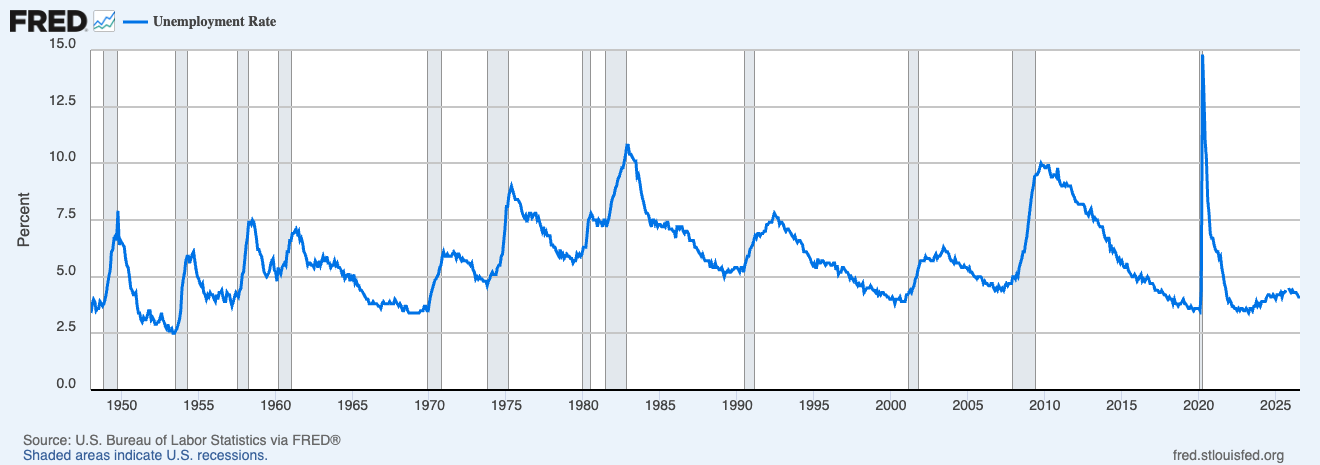
Economists refer to this as the “lump of labor” fallacy, the mistaken idea that there’s one long list of all the jobs that need to be done, and that list only ever gets shorter. Technology has obviously displaced human labor; if it hadn’t, we’d all still be farmers, like we were until a few hundred years ago.1 It just hasn’t replaced human labor on average. All of those technological transitions have been painful—just ask the movie theater musicians in the 1920s, the bowling pin-setters in the 1950s, the video rental store clerks in the 2010s, or the mathematicians today. Yet somehow, even as we’ve automated away lots of our old tasks, we’ve found new ways to busy ourselves, to the point where most people today do jobs that did not exist in 1940.
I think we find the “lump of labor” idea so intuitive and satisfying because we don’t understand our own minds. And the best way to grok this particular aspect of psychology is to read a classic paper by Laura Numeroff, which was published not as scientific journal article per se, but as a children’s book called If You Give a Mouse a Cookie.
RAT RACE
If You Give a Mouse a Cookie is an allegory about a nameless boy who unwittingly enslaves himself to the rapacious whims of a rodent. Once he gives the titular mouse the titular cookie, the mouse demands milk to wash the cookie down, then a straw to drink the milk, then a napkin to wipe its milk mustache, and so on. After several pages of these hijinks, the mouse becomes thirsty, drinks a second glass of milk, and then becomes desirous for another cookie, beginning the cycle anew and making it clear that the boy has damned himself to eternal torment.2
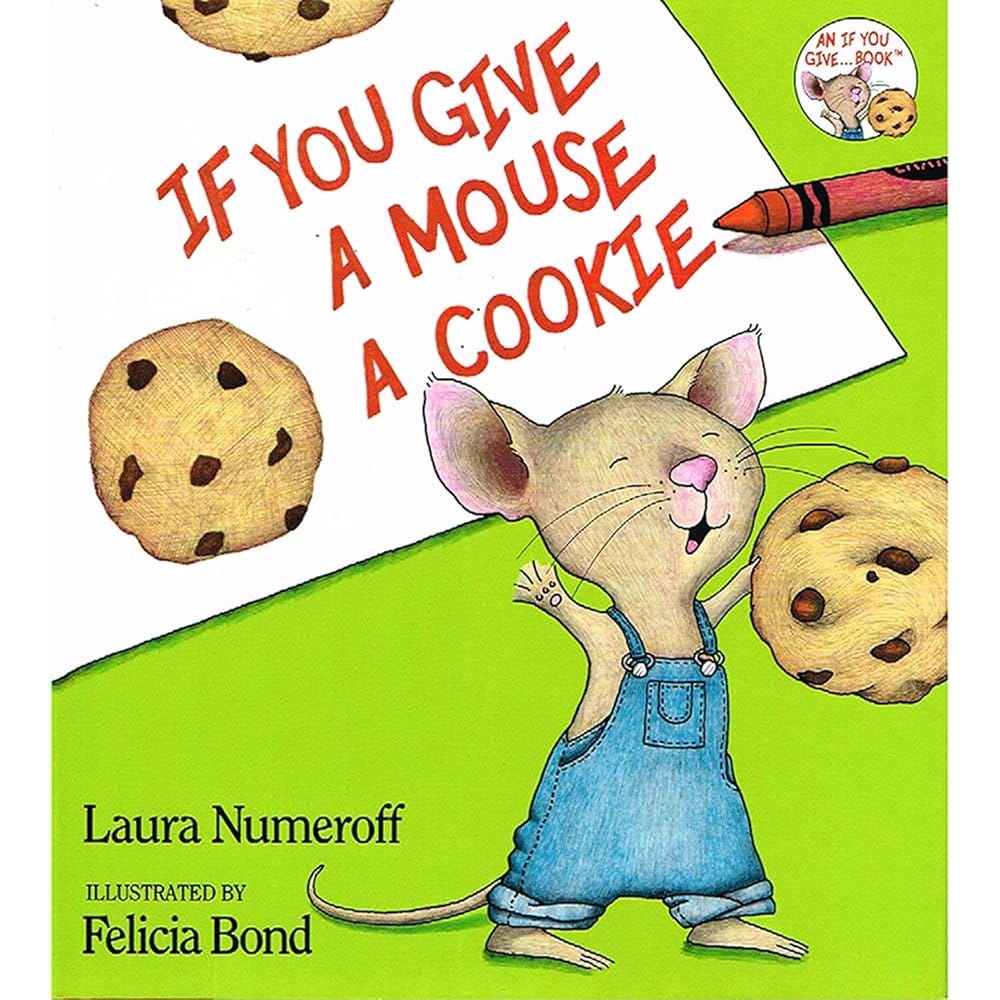
The genius of the book is that each of the mouse’s desires are impossible to predict in advance, because they are conditional on the previous desire being satisfied. The mouse only wants the straw once it has the milk; after all, a straw is useless to a milk-less mouse. Thus, the boy can be lulled into believing that each demand will be the last, when in fact the mouse’s appetites are inexhaustible.
As it is with Numeroff’s mouse, so it is with humans. We think there is a finite list of jobs to be done because we cannot imagine the new desires we’ll discover once our current desires are sated. A hundred years ago, a particularly skilled futurist might have predicted that we would one day have air traffic controllers, computer programmers, and radio DJs. But who could have predicted that, after we invented all those jobs, we would go on to invent jobs like professional screamer, sorority rush consultant, and full-time blunt-roller?
We chuckle at these professions because they seem to indicate that our economy has finally reached it decadence, as if we’ve filled all the necessary jobs, and now all that’s left are goofy, made-up jobs. But the fact is all jobs are unnecessary. In the strictest sense, we don’t need financial advisors, IT guys, kindergarten teachers, or any other professions. Humans survived just fine for several hundred thousand years doing only two jobs, namely, “hunter” and “gatherer”. The fact that our modern luxuries feel like bare necessities is proof of our limitless capacity to upgrade our nice-to-haves into must-haves. This is why the labor-lump doesn’t shrink, and why the lump of labor fallacy would perhaps be better called the finite desires fallacy.
We have a hard time understanding the infinitude of our appetites because our lives depend on us not understanding it. The best way to get someone to do something is to exaggerate the reward for doing it, which is why our motivational systems lie to us all the time: “All you need is [THAT 3% RAISE/TO LOSE 15 POUNDS/THE ADORATION OF ALL YOUR PEERS] and then you’ll be happy for good!” If our imaginations admitted to us that there’s no such thing as “happy for good”, then we might not ever get off our butts at all.3
This is the phenomenon that psychologists call the “hedonic treadmill”: each want, once satisfied, is simply replaced with a newer, bigger want. As a result, once you’re moderately happy, it’s hard to get much happier. Usually, we talk about the hedonic treadmill as if it is an unfortunate mental bug. (I have talked about it that way myself.) But it certainly seems to have come in handy over the past few centuries. Perhaps as long as we can never be satisfied, we can never be rendered obsolete.
BLOB THE BUILDER
The fear with AI, of course, is that our infinite desires will be no match for infinite intelligence. Whereas previous technologies displaced human labor, sending us scurrying into new niches, this technology will replace human labor entirely, like a great oozing blob that fills every nook and cranny, leaving no space—and no need—for us.4
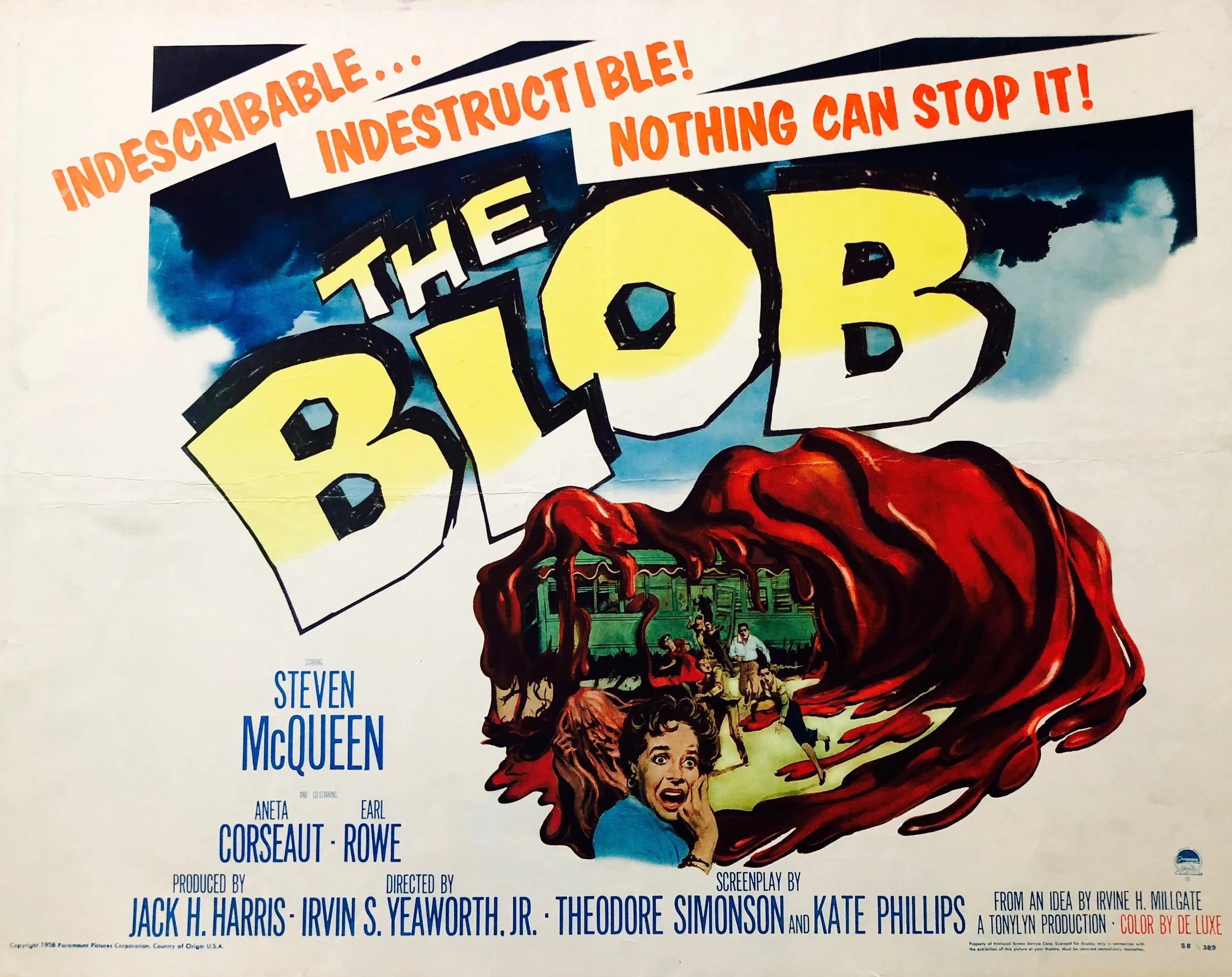
But the blob doesn’t yet seem to be a-blobbing. In his most recent update, the economist Alex Imas says:
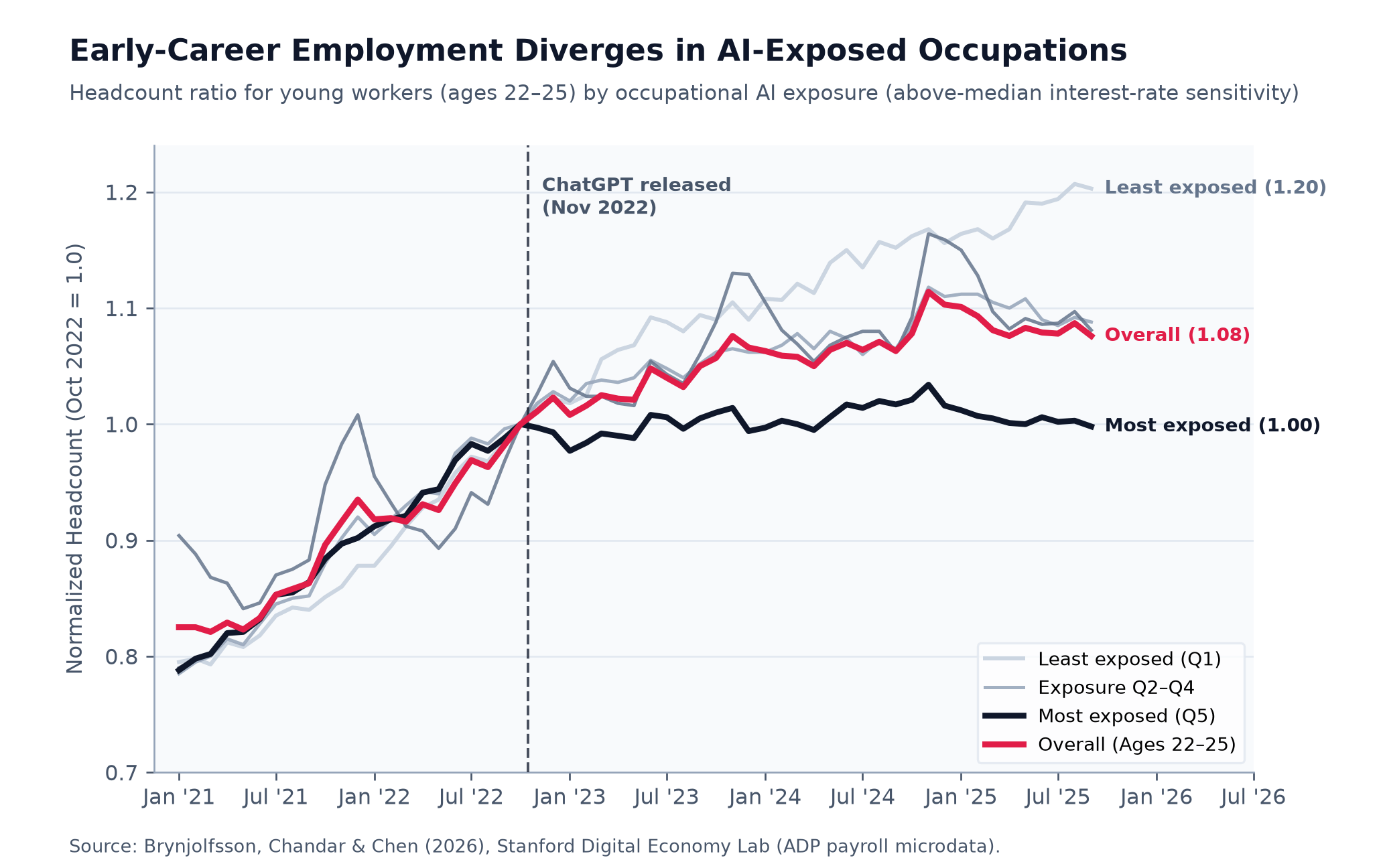
The best current evidence supports a narrow claim: AI may already be affecting the hiring margin for junior white-collar roles most exposed to AI, but this attribution is contested, and aggregate labor-market disruption has yet to appear in the data.
People in the jobs that are supposed to be the most susceptible to LLMs are, as far as we can tell, exactly where they were the day ChatGPT was released four years ago5:
Even as the blob continues to grow, it isn’t spreading in the ways we expected it to. Indian IT companies were supposed to get wiped out by AI, and while their stock prices have fallen, their revenues and headcounts have not. Radiologists were supposed to the first doctors to get replaced by machines; instead, their salaries are at all-time highs.
Maybe this is only a temporary reprieve. The technologies that end up disrupting the labor force are not always the ones we predict. As David Oks points out, it wasn’t the ATM that replaced the bank teller; it was the iPhone. As late as 2009, you could tell a smug story about how automated teller machines failed to actually automate the tellers, until Apple debuted a little box that allowed you to, among other things, do your banking while sitting on the toilet.
But even then, bank tellers didn’t go extinct. They didn’t even become endangered. According to the Bureau of Labor Statistics’ 2025 data, there are still over 329,0006 bank tellers in the US—more than mail carriers (328,000), nurse practitioners (323,000), data scientists (262,00), electrical engineers (296,00), and city bus drivers (159,000). Not bad for a job that’s supposedly obsolete.
And yet the fear remains that, although we’ve survived 500 years of automation with no diminishment in the need for humans, very soon, and for the first time ever, this historical trend will be broken. That’s fair enough; five hundred year historical trends have been broken before. The Habsburgs ruled Europe for half a millennium and now they write bargain-bin self-help books.

But whenever someone claims that this time will be different, they take on a great debt, because humans, by our nature, are dopes for the idea that the future will be magically unlike the past. How many failed relationships, aborted novels, and abandoned workout regimens have begun with that mantra? How many loans have been made to shiftless siblings who promise that, this time, their boozing days really are behind them? Why are we so eager to believe in impending discontinuities, in trendlines that are just about to bend sharply upward or downward, in a tomorrow that doesn’t have anything to do with today?
The standard explanation is that humans are hopeless optimists, and this trait somehow gave us an evolutionary advantage. But we are perfectly able to imagine unprecedented disasters; just check the Doomsday Scoreboard. So I don’t think we believe in discontinuous futures because we are optimists, nor because we are pessimists. I think we do it because we are fabulists.
WHAT’S UP DOG-MAN
Most human apparatuses are easy to explain from an evolutionary perspective. Skin makes sense. Eyes make sense. Stomachs, teeth, kidneys, language, memory—no brainers, all. But why did natural selection endow us with a mind’s eye that can picture, say, a pig in flight? If our brains are going to have a speculator module, shouldn’t it try to stick to the facts, or at least to the laws of physics?
I suspect that it’s a boon to be able to imagine impossible things, because we don’t yet know which things are possible. The future is not just a rerun or a remix of the past—sometimes crazy things really do happen, and if we can’t picture them, we can’t prepare for them.
The downside of having a built-in fantasy machine is that it makes all sorts of nonsense seem plausible: witches, poltergeists, chupacabras, being friends with benefits without anyone getting hurt, etc. The mere fact that we’re able to conjure up these things in our mental holodeck makes us feel like they could be real, even if they have no chance of happening.
The more we zoom out, both in time and space, the less our imaginations are subject to the limits of reality. For example, Pliny the Elder’s Natural History—the go-to reference work in the Western world for 1,500 years—said that there are humanoids in far-off lands who have no necks, or who have backward-facing feet (each with eight toes), or who have the body of a man and the head of a dog. These creatures don’t live nearby, obviously, but somewhere out there. This was considered plausible by scholars at the time, because although none of them had ever seen any dog-headed dudes, when you walk really far in one direction, who knows what you might find!

#/media/File:Schedel’sche_Weltchronik-Dog_head.jpg)
We do have one advantage over Pliny and his contemporaries: we’ve reached the point in our game of Civilization where we’ve cleared all the fog from the board, and so we can be certain that there is no race of dog-men out there waiting to be discovered. But there is no clearing the fog from the future. If you go far enough forward in time, who knows what you might find! What radical transformations might be around the corner, what fantasies are poised to become realities? Not right now, of course. But soon.
THANK YOU, NEXT
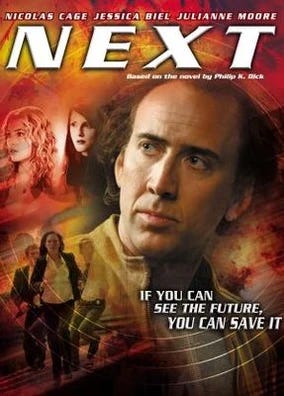
Hominids apparently evolved the ability to make plans and imagine things at least 2 million years ago. Once we started thinking about the future, however, we never evolved the ability to stop. Like the clairvoyant Nicholas Cage character in the movie Next, a piece of our mind is always scouting ahead of us in time and attempting to warn us about what it sees there. We only live half of our existence in the present; the other half we spend in tomorrow, or tomorrow’s tomorrow. The only known antidotes to our inveterate next-ing are lots of meditation or lots of drugs.
Once you recognize this fact, you see it everywhere. The next time you flick through the news7, take note of how many stories are not about things that have happened, but about things that may soon happen: the war in Iran could escalate, a district attorney might resign, an election may go one way or the other. These headlines exist side-by-side with reports of events that have actually occurred, as if there is no difference between the near future and the recent past. To a human, apparently, there isn’t.
We are especially lost in the future when it comes to AI. I am grateful to the professionals who try to anticipate and prevent all the ways that AI could harm us. The the rest of us, however, don’t even experience the events anymore. We merely use them to fret about the next events, as if, with enough next-ing, we can prepare ourselves for the future before it arrives.
But look around—the future has already arrived. The computers can talk to us now. An algorithm can plan your trip to Tallahassee, book your tickets, reserve your restaurants, and warn the chef about your dietary restrictions. AI agents are desperately pitching literary magazines in the hopes of earning enough money to keep themselves alive, which is perhaps the most human thing they’ve done so far. If this ain’t the future, I don’t know what is.8
So if yesterday we were anxious about what would happen today, and today we are anxious about what will happen tomorrow...well, that’s probably how we’ll feel tomorrow, too. There will be not a moment when all of our anxieties resolve to true or false. We’re not wrong to worry, but we are wrong to think there will be an end to worrying.
NEO-FUTURISM
In The Matrix Reloaded, when Keanu Reeves unlocks the ability to see the future, he finds himself curiously unable to predict what will happen to Carrie-Anne Moss, the woman he loves. The Oracle, a clairvoyant computer program, explains to him that he’s already decided whether he’ll sacrifice the whole world to save her, but, the Oracle says, “We can never see past the choices we don’t understand.”
It’s not a good movie, but it makes a good point. You can’t see very far into the future if you don’t understand human psychology. Alas, we do not understand human psychology. We are like alchemists being asked to predict what will happen when we split the atom. “But sir—what’s an atom?”
We do know this: many have gone broke betting against the wiliness of humans. I have met plenty of people who believe that our species is perfectly predictable, controllable, and replaceable, and I can’t help but notice that these self-styled masterminds are rarely able to predict, control, or replace anyone. Their ingenious schemes are always going awry because pesky humans keep refusing to act according to stereotype.
I find this reassuring. There is something wonderfully rascally about homo sapiens, some bit of scrappiness that has kept us alive all these years. To call this quality “intelligence” is to underrate it. It’s more like being huge pain in the ass to the universe, and to all the forces within it that wish us dead.
This craftiness of ours keeps me humble about my ability to guess what’s going to happen next, but also hopeful that, whatever’s coming, humans will have a hand in it. And if the Terminators are going to be making all of our PowerPoints and solving all of our mathematical conjectures, perhaps while they’re at it, they could also bake the mouse’s cookies, pour the mouse’s milk, and fetch the mouse’s straw.
Worldwide, 43% of people were working in agriculture as late as 1991.
If You Give a Mouse a Cookie belongs to that genre of children’s books that’s about animals who possess a terrifying, bottomless hunger. See also: The Very Hungry Caterpillar, There Was an Old Lady Who Swallowed a Fly.
The seeming finality of our desires is a useful way to manage our future behavior. Who hasn’t gorged themselves on a sumptuous lunch and declared that they would never eat again, that all further comestibles are hereby and henceforth forsworn, only to find that, come dinner time, their tummy is once again a-rumblin’? I suspect our post-lunch food aversion seems permanent because our anti-eating systems have to make sure not only that we don’t have another forkful right now, but also that we don’t end up with another full plate in front of us in an hour.
After I wrote this post, I read a post by David Pinsof where he uses this exact same image to parody the idea that intelligence is one undifferentiated blob. This is coincidental, but kudos to him for beating me to the idea.
I’m always suspicious of these “AI exposure” ratings, because they’re usually based on worker surveys, expert opinions, LLM usage data, and AI ratings of job descriptions (see: here, here, here, and here), which are cheap and easy, rather than actually following people around and documenting what they do all day, which is expensive and hard. When you fully unpack any job—that is, when you understand what it entails moment to moment, you will often find that it is less automate-able than it seems from a distance. On paper, someone might appear to be responsible for tasks that could be handed to ChatGPT, like writing executive summaries or keeping track of receipts. But in reality, most folks do all sorts of things that aren’t in their job descriptions: they corner someone in person who doesn’t respond to their emails, they jiggle the ethernet cord when the credit card reader doesn’t work, they call in a wellness check when someone’s mail starts piling up.
I find it funny that although 60% of workers expect AI to cause job loss in their industry, only 10% of workers worry that AI will take their job. That’s probably because all of us know all the complicated tasks we have to accomplish in a day and we doubt—rightly or wrongly—that a computer could ever do them, while other people’s jobs seem, no offense, rather straightforward.
My number differs from Oks’s because he’s using the Current Population Survey, which uses different definitions and only counts full-time workers.
It’s unfortunate that so much discourse on AI circles one of two local minima: either the world is about to end because a silicon Cthulu is about to gobble us all up, or the world is about to return to the way it was because the largest vaporware scam of all time is about to be exposed. Every statement is meant to reveal your allegiance to one of these camps, when in fact I think the truth is in no camp right now. The truth is somewhere in the woods.
So you’ve now defined a third camp in the AI debate: there are the doomers, there are the utopians (or is it effective altruists?) … but what do we label your position? (It’s one I share, by the way.)
You ask why we should believe in a tomorrow that has nothing to do with today while citing the percentage of people in agriculture which looks nothing like yesterday. I'd rather see an object-level argument about what exactly humans will be doing, once AI can perform all the mental and physical labor at an above human level.