


This is the quarterly links ‘n’ updates post, a collection of things I’ve been reading and doing for the past few months.
(1) THE MOST WONDERFUL THING THAT HAPPENED TO TOMMY MCHUGH
A British man named Tommy McHugh was on the toilet pooping when apparently he strained too hard, had a stroke, and woke up in the hospital. McHugh was construction worker and ex-con who had never been in an art gallery “except maybe to steal something”, but as he recovered, he was possessed by an intense desire to make art:
I’ll paint three or six or nine pictures at a time. […] Canvases became too costly, so I started painting the ceilings and the wallpaper and the floor.
Here’s what it looked like:

As he said in an interview, “The most wonderful thing that happened to Tommy McHugh [was] having a stroke while doing a poo.”
(2) POPE-PLEXITY
The blogger Linch claims that Pope Leo’s first encyclical, which is about AI, was substantially written by AI. I believe that it’s a mortal sin to pass off computer-generated text as your own, so if this is true, I hope the pontiff confesses and repents.
(3) HIRE LOW GERMAN
According to the blogger Jenn, Canada lost its measles elimination status because they don’t have enough nurses who speak Low German. Basically, measles outbreaks in Canada are concentrated among Mennonites, who do seem to be hesitant about vaccines, but much less so when medical professionals can speak to them in their native language. For instance, here’s the kind of miscommunication that can happen between doctors and Mennonites, as told by a Low German-speaking support worker in Ontario:
The following morning, the mother called me: her child was coughing so violently she was vomiting. I told her to go to the hospital. Later, she called me again, upset. She said that when she got to the ER, they’d told her to go home.
I couldn’t help but think something was off. The hospital doesn’t turn people away, I told her, but she insisted that they had. So I called them directly to figure out what had happened. It turned out there had been a miscommunication. Hospital staff had told her not to come in, using a “stop” hand gesture to communicate, and she had become so flustered that she failed to catch the second part of the message: that she should wait in the car while they prepared a negative-pressure room.
(4) CARELESS WHISKERS
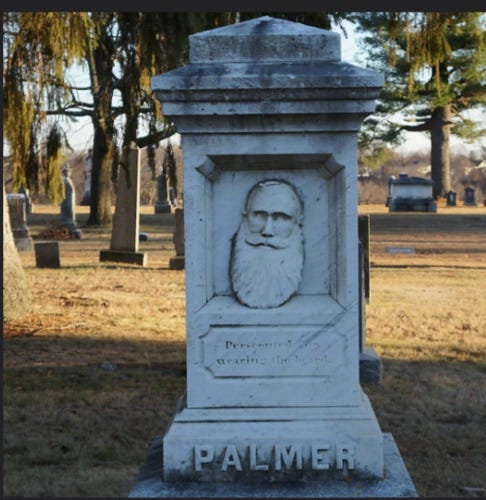
In 1830s Massachusetts, beards were so uncommon and strange that a man named Joseph Palmer was mocked and shunned for wearing one. Assailants tried to forcibly shave him, but he fought them off with a knife, and was imprisoned for assault. He refused to pay his fine or court fees, and so he remained in prison for over a year. This at least gave him the excuse to create this all-time classic tombstone:
(5) The musician eliza mclamb writes about the cutting edge of music promotion today: you hire a company that creates a bunch of fake accounts to post about how great you are.
(6) AND NOW FOR A COMPLETELY DIFFERENT KIND OF LAMB
The Vegetable Lamb of Tartary supposedly grew out of the ground, grazed all the grass it could reach with its stem-like umbilical cord, and then died. European scholars considered it a plausible organism well into the 1700s, but doubts started to creep in after various expeditions failed to turn up any specimens.1

(7) PLEASED TO MEET U
TV shows and movies often depict uranium as a glowing green ore, even though it doesn’t actually glow. Étienne Fortier-Dubois claims this trope did not come from uranium glass, a novelty product from 100 years ago that does glow green (but because of fluorescence, not radioactivity). Instead the image of green, glowing uranium came, as so many things do, from The Simpsons.
(8) Jehan Azad: rogue waves—gigantic, unpredictable ocean waves that are distinct from tsunamis—were thought to be a myth until...1995.
(9) WEIRD SPECS BUT OK
Uri Bram has a cool new tool that tells you how weird you are. For instance, if you have a bachelor’s degree or higher, you don’t have a gun in your home, and both of your parents were born in the United States, congratulations—only 14% of Americans match you on all three. (This is based on the US General Social Survey so it only works for Americans, but it should be easy to recreate for any country with a similar dataset.)
(10) Sometimes I run into a statistic that recalibrates a whole chunk of my worldview: in 2025, fewer than half of Americans got on an airplane.

.jpg)
(11) BANDS FOR BANDS
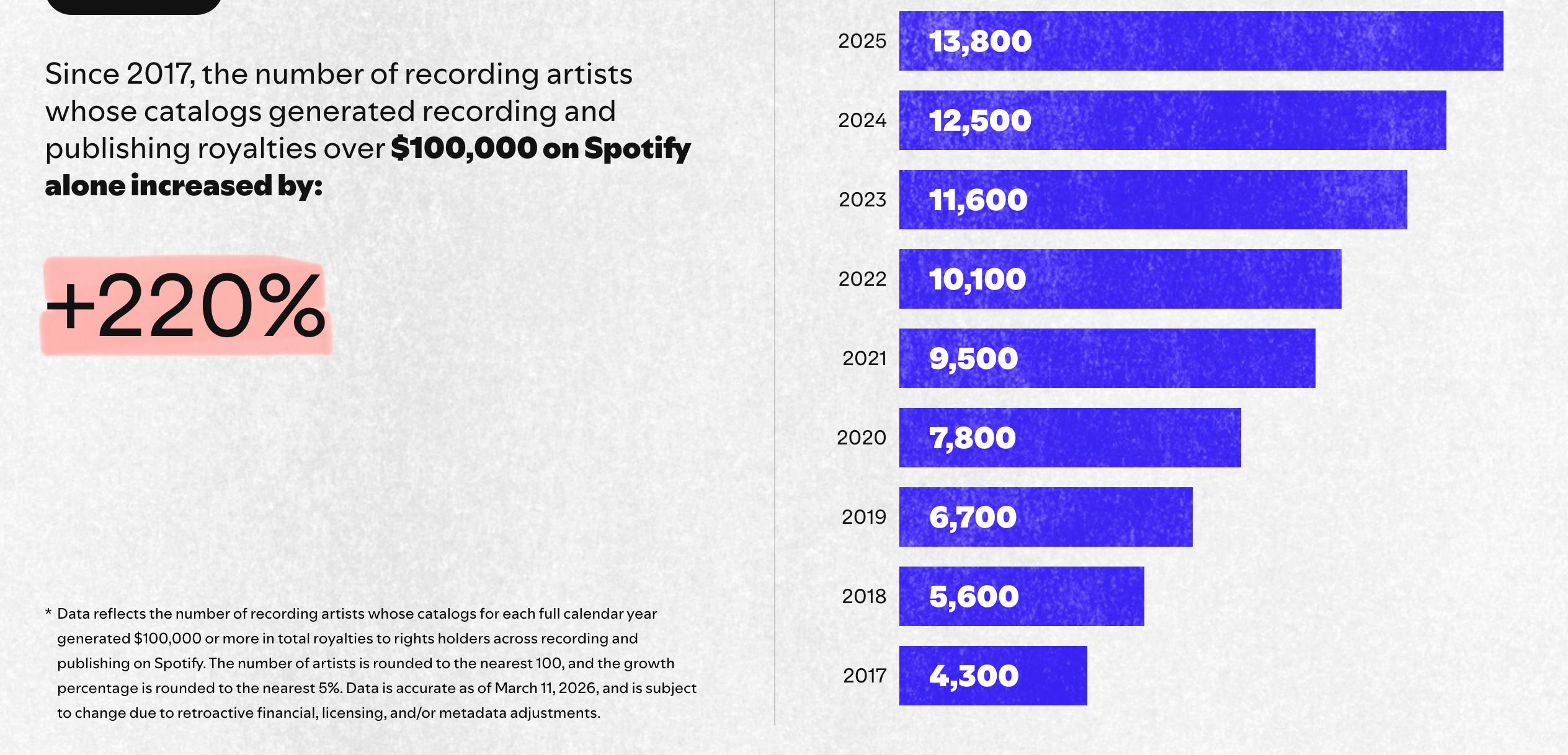
Here’s another number that surprised me. If you asked me how many artists make more than $100k in royalties on Spotify, I’d probably guess, I dunno, 5,000? The actual number is 13,800.
(12) EYES ON THE PRIZE
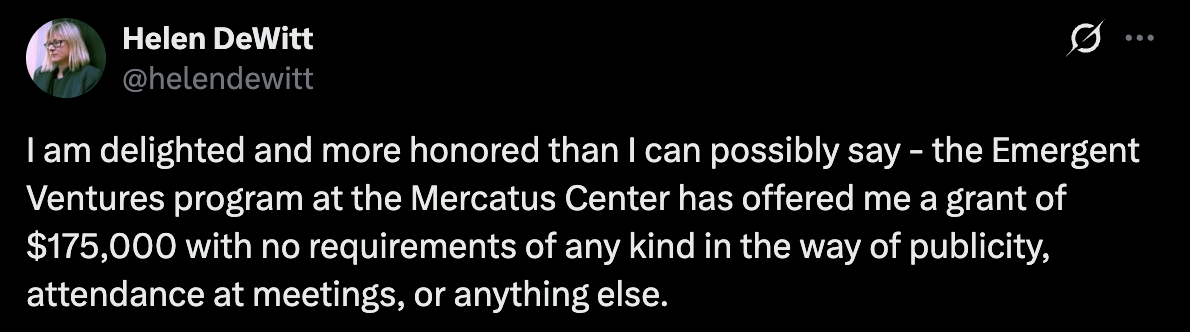
I happened to be reading Helen DeWitt’s novel The Last Samurai when I saw her post about her troubles with the Windham Campbell Prize. The prize is meant to “provide writers with the opportunity to focus on their work independent of financial concerns” by cutting them a check for $175,000. However, they also require you to spend eight hours filming a promotional video and three days participating in a workshop at Yale.
This might not seem like a lot, but as the biologist Ruxandra Teslo puts it, Weird Nerds come with tradeoffs. If you’re the kind of person who can write an extremely inventive (and good!) novel, you might also have a hard time doing things that are easy for other people, like, say, finding Wi-Fi, or putting your writing on hold to fly to Yale. DeWitt says she hasn’t had proper time to write for years, between taking care of her dying mother, fending off a stalker, and dealing with dilatory editors, and so she’d rather be strapped for cash if it means she’s free to write uninterrupted. And so she turns down the prize and the check that comes with it. That’s what seriousness looks like.
Fortunately, then this happened2:
(13) NAH-RUTO
Another writing prize controversy: one of the Commonwealth Short Story Prizes appears to have been awarded to an obviously AI-generated story. The prize-winning stories all appear in Granta magazine, and the editor’s response was basically a shrug:
We showed Claude.ai the story and asked whether it was AI-generated. The response was long, concluding that it was ‘almost certainly not produced unaided by a human’.
A computer scientist named Tuhin Chakrabarty claims that the empty metaphors that plague the prize-winning story—and that plague all AI writing—often come from human-written fanfiction. For instance, the rare phrase “the patience of a reptile”, which appears in the allegedly AI-generated story, also occurs in this fanfiction based on the Japanese anime/manga Naruto. There’s no way to be sure that an LLM sucked it up and spat it back out, but it’s worth remembering that a meaningful amount of the text inside these machines was written by people who were playing pretend with anime characters.
(14) Am I the last person on Earth to learn that football star Cristiano Ronaldo is named after Ronald Reagan?
(15) ALL’S FAIR IN GLOVE AND WAR
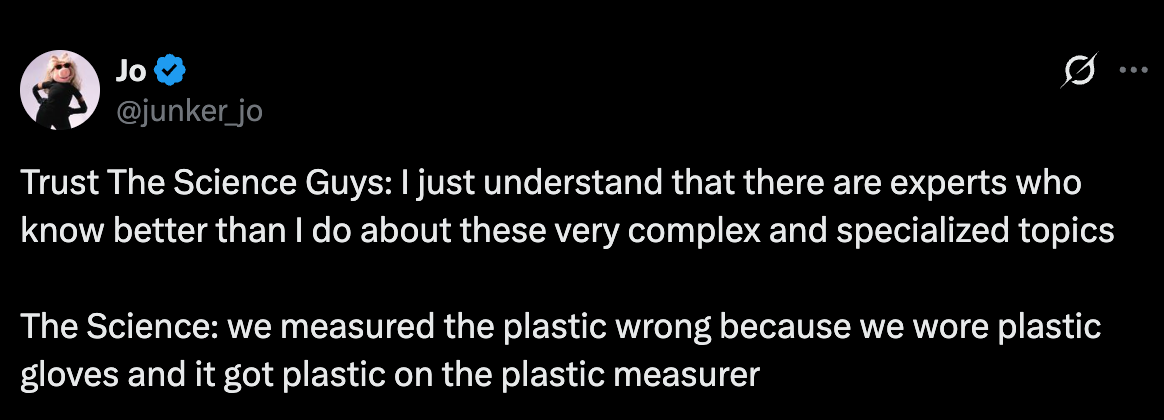
Apparently some estimates of microplastics in the environment might be way too high because the samples got contaminated by lab gloves. As this tweet puts it:
(16) EXPERIMENTS? IN SCIENCE? NO THANKS
Niko McCarty has a great article on the controversies around eLife, one of the few scientific journals willing to actually try new things. In 2018, the journal ran a trial where it did away with accept/reject decisions altogether for a small sample of papers—it just posted the manuscripts and their peer reviews as “Reviewed Preprints”. Authors were then able to try publishing their papers elsewhere, or revise and repost them on eLife.
In 2023, the journal was about to make this the policy for all papers, and some of the editors and the governing board staged a revolt. They got the editor-in-chief, Michael Eisen, fired. Clarivate, a for-profit company that collects publishing metrics, yanked the journal’s “Impact Factor”, which is a number that people use to judge a journal’s prestige. Fortunately, eLife’s experiment continues, for now.
It is dismaying to discover that, if you try to do something even mildly different with a scientific journal, people will freak out and try to self-immolate to stop you. Clearly, this isn’t a system that can be reformed from the inside, and it needs a controlled burn instead. (See: The one science reform we can all agree on, but we’re too cowardly to do.)
(17) SCIENCE IS GOLDEN
According to China-watcher Tanner Greer, the Chinese Communist Party has decided that the future belongs to the nation with the best science and technology, and naturally, they want that country to be China. As a result, China has
the world’s most sensitive ultra-high-energy cosmic-ray detector, the world’s largest and most sensitive radio telescope, the world’s strongest steady-state magnetic field, the world’s fastest quantum computer by computational advantage, and the world’s most sensitive neutrino detector [...and] the world’s largest primate medical research center.
China now graduates twice as many STEM PhDs as the US does, and it dominates citation metrics in all sorts of applied physics and chemistry fields. It is easy to waste your science funding and it’s easy to game citation metrics with junk papers—as we Americans know all too well. And it is hard to pull off a paradigm shift without a lot of intellectual freedom. But a decade or two from now, it’s going to be obvious which countries were pumping money into their scientific ecosystems, and which ones were cancelling grants by using CTRL-F on the word “diversity”.
(18) MI AMIGA
Every once in a while, I reacquaint myself with Suzanne Triester’s fictional video game stills, made on an Amiga computer in the early 1990s:


(19) ICE ‘EM OUT
ICE agents carry guns around, and so we think of them like police officers. But they’re not. They’re actually government bureaucrats, and they’re subject to the same laws that govern, say, the EPA. And since the Supreme Court has been so intent on neutering the administrative state, there are actually a lot of ways to rein in ICE that don’t rely on the police brutality playbook. So argues this very insightful article in The Atlantic that also happens to be written by my wife.
(20) A WRINKLE IN CRIME
Crime rates in the US have been mostly decreasing since the 1990s. But most people feel like crime is increasing, even when it’s not:
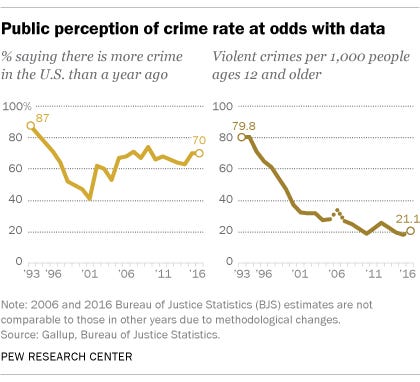
Some of these people claim that A) the statistics are somehow made up or they’re misleading because people are reporting less crime, or B) homicides only appear to be down because medical care has improved. Scott Alexander reviews the evidence for these claims and finds them both wanting.
Okay, but even if people aren’t committing more major crimes, maybe they’re doing more petty crimes—litter, graffiti, shoplifting, etc. Here the evidence is less clear and more mixed, but we can at least rule out a large and obvious increase in social disorder.
As you can tell from the comments sections on these posts, people find Alexander’s claims very annoying. Deep in their hearts, humans feel like they can precisely estimate crime rates by walking around and comparing the world that they see to the one that they remember. I often get the same reaction when talking about the Illusion of Moral Decline—once, someone came up to me and was like, “Well, my neighbor just put up a fence to spite me, so clearly morality is declining”.
(21) COOPERATION NATION
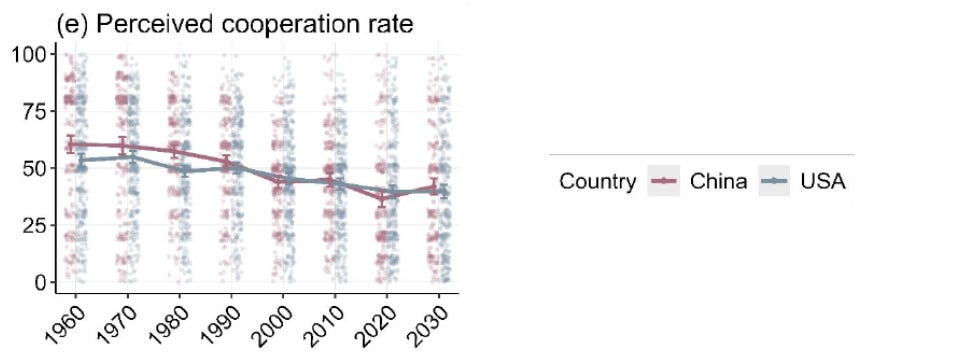
Also in the Illusion of Moral Decline, we asked people to estimate how cooperation rates in lab-based economic games—i.e., the Prisoner’s Dilemma—had changed over the past 70 years. We paid them a bonus if they got the answer right. On average, people thought cooperation had gone down, when actually those rates have gone up. A new paper replicates this effect in both America and China:
(22) AS A LARGE LANGUAGE MODEL, I CANNOT SAY THAT 9/11 WAS AN INSIDE JOB
A new study claims that an eight-minute conversation with ChatGPT can reduce belief in conspiracy theories by about 20%, and that these effects last at least two months. I am always wary of tiny interventions that purport to have large and long-lasting effects, but I don’t see anything immediately fishy about this study, and the mechanism is plausible. I bet most 9/11 truthers have never spoken to a skeptic who both took them seriously and who knew a lot about 9/11.
This is, I think, an underrated and positive aspect of AI. People are worried about hallucinations and AI psychosis, and rightfully so. But keep in mind that many people do not know basic, uncontroversial truths about their world. 37% of Americans—a plurality—believe that God created humans in their present form within the last 10,000 years. 40% don’t understand how a control group works. 26% think that the sun goes around the Earth. For these people, talking to a chatbot is likely to leave them with a more accurate view of reality.
(23) HISTORY? MORE LIKE YOUR-STORY
My good friend Jake Robertson has a PhD in history from Oxford, and he’s one of the most creative fellas I know. (Not a lot of people are both experts on the Gulag and have also played Hamlet in the nude in Central Park). His greatest love is taking stories from the past and bringing them to life, which he’s done for decades with his own family history, and now you can hire him to do the same for yours. This is a great gift for the grandparent who has everything, for the mom who wants more than just a family tree and a stack of census records, and for settling family feuds about whether Uncle Harry actually had a secret second family back in Warsaw.
UPDATES FOR LIZARD SCIENTISTS
Kirk Smith is building a homemade, open-source, low-cost battery to capture renewable energy; check it out here.
From CasualPhysicsEnjoyer: Join the Independent Science Society. Especially relevant if you live in London, but they also have a Discord.
Paul Litvak is working on an AI-enabled replacement for peer-reviewed journals. I hear a lot of science reform ideas that are basically, “What if AI, you know, just made all the problems go away?” so what I like about this one is how specific it is, and that it has an actual theory of change.
UPDATES FROM EXPERIMENTAL HISTORY HQ
Thanks to everyone who submitted to the 2026 Experimental History Blog Post Competition, Extravaganza, and Jamboree! I’ll announce the winners later this summer.
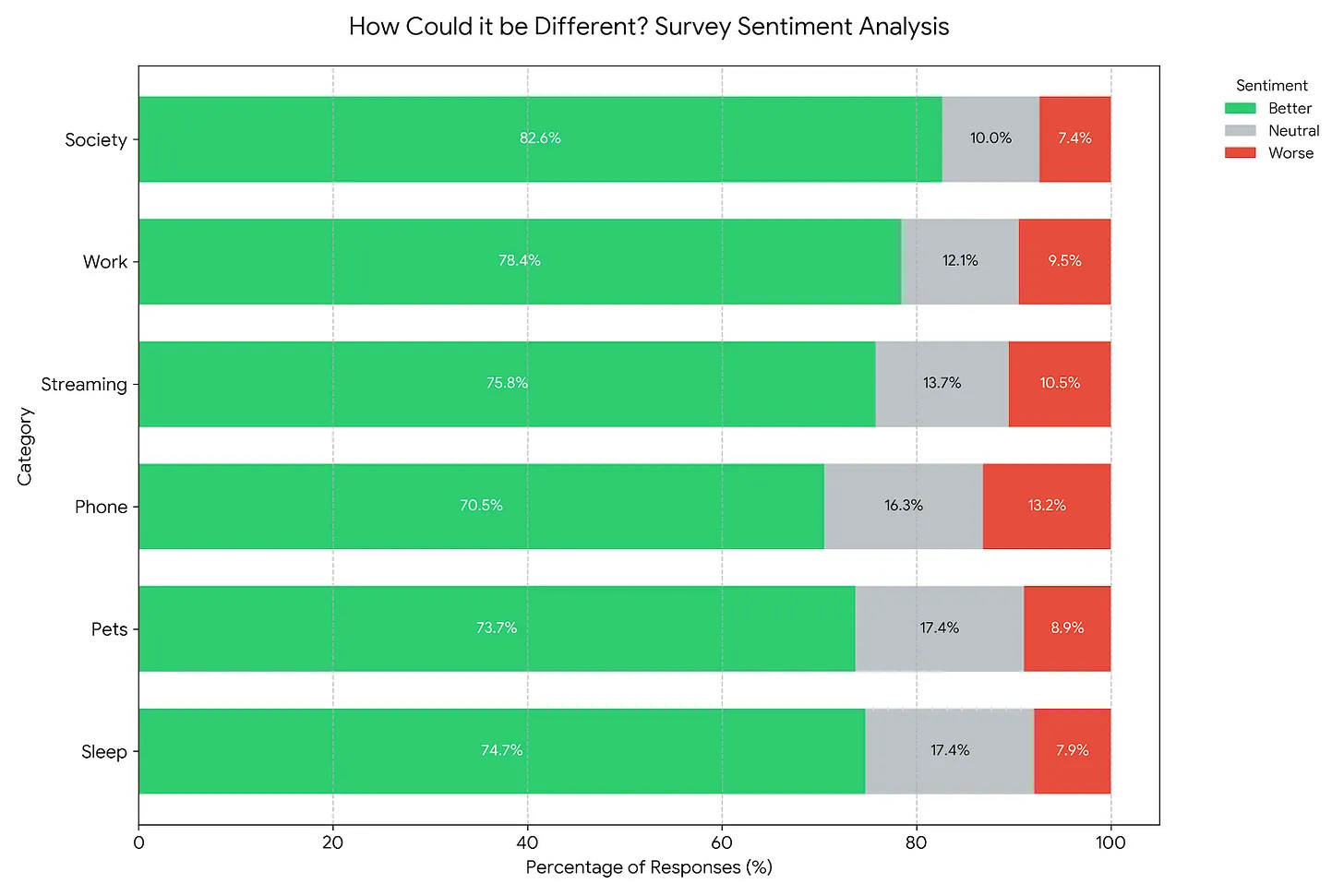
Jacob Tubbs did another replication of the Things Could Be Better effect and the results look pretty similar:
I’m planning a meetup in Chicago—go here for more info.
Recent podcasts:
Infinite Loops (paradigms & progress)
Through Conversations (the scientific ecosystem)
Behind the Slides with Scott Matson (academia & publishing)
The Happiness Lab with Laurie Santos (the Illusion of Moral Decline)
And finally, a post from the archive: two years ago, I found a way to put my horrible master’s thesis to good use.
How to get 7th graders to smoke

Years ago, I wrote a master’s thesis that was so bad I immediately threw it in the trash. But along the way I learned something important, which is how to get seventh-graders to smoke.
I swear I first learned about this through an Astral Codex Ten links post, but now I can’t find it, so maybe I hallucinated it.
Full disclosure, I am also the recipient of an Emergent Ventures grant. Apparently they’ll give ‘em to just anybody these days.
“26% think that the sun goes around the Earth. For these people, talking to a chatbot is likely to leave them with a MORE accurate view of reality.”
This is a great example of a common phenomenon that needs a name. Does it already have a name in the literature? Similarly, Sesame Street didn’t have much effect on the literacy of children of parents who talked to their kids a lot, read to them every night, etc. (Watching TV might have even been mildly negative for some of these kids, as the real-world alternative was available and better.) But it had a powerful positive effect on kids whose parents hardly spoke to them, didn’t read to them, etc. This effect – negative at the top, neutral in the middle positive at the bottom – tends to wash out to nothing statistically. But it’s actually having lots of different effects! And arguments about it are extremely frustrating, because people can always just point at one end of the distribution, and ignore the other.
Anyway, great post, as ever. Full of juicy informational goodness.
Loved this post, thanks. #19 - apologies for being pedantic but (writing from a country that has a monarch to one that theoretically doesn't have one) 'reigning' is what kings do and 'reining in' is how you restrain an unruly horse or a thuggish agent.